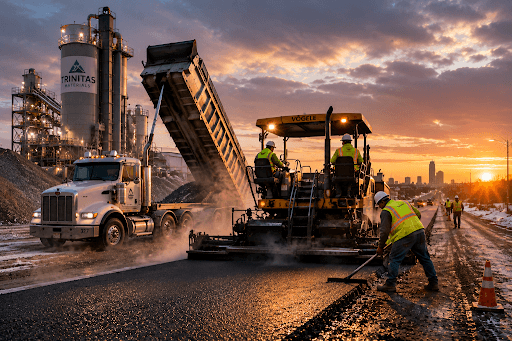
Road performance is often judged years after construction is complete.
Smooth surfaces, minimal cracking, and consistent durability are signs of a project done right. But those results are not created at the end of the process.
They are determined at the beginning.
Material quality plays a central role in how a road performs over time. When the right materials are selected and applied correctly, the structure holds up under stress. When quality is compromised, problems begin to appear much earlier than expected.
Why Material Quality Is Often Overlooked
In many projects, attention is paid to timelines and costs.
While both are important, they can sometimes shift focus away from material selection. It becomes easy to assume that similar materials will produce similar results.
That is not always the case.
Differences in composition, consistency, and durability can significantly affect how a road performs under real conditions. These differences may not be visible during installation, but they become clear over time.
The Connection Between Materials and Structural Integrity
A road is not just a surface.
It is a layered system designed to handle load, movement, and environmental stress. Each layer depends on the materials used to maintain its strength and stability.
If the base materials are inconsistent or not properly suited for the project, the entire structure is affected. Load distribution becomes uneven, and stress begins to concentrate in specific areas.
This leads to early wear and reduced lifespan.
How Low Quality Materials Lead to Early Deterioration
When material quality is inconsistent, performance declines more quickly.
Cracking is one of the most common signs. It often starts small but expands as the structure weakens. Potholes can form when the surface breaks down under repeated stress.
These issues are not just cosmetic.
They indicate that the materials are not holding up as intended. Repairing them requires time and additional resources, which increases the overall cost of the project.
The Role of Consistency in Material Performance
Consistency is just as important as quality.
Even if materials meet general standards, variations within a batch can create weak points in the structure. These inconsistencies affect how the road responds to traffic and environmental conditions.
Uniform materials provide predictable performance.
They allow engineers and contractors to design with confidence, knowing that the structure will behave as expected.
Environmental Factors Amplify Material Weakness
Roads are exposed to changing conditions.
Temperature shifts, moisture, and heavy traffic all place stress on the structure. High-quality materials are designed to handle these variables.
Lower-quality materials are more vulnerable.
They expand and contract unevenly, absorb moisture differently, and degrade faster under repeated use. Over time, these factors accelerate damage and reduce the lifespan of the road.
Long-Term Cost vs Initial Savings
Choosing lower-cost materials may reduce upfront expenses.
However, the long-term impact often outweighs the initial savings. Roads that require frequent repairs or early reconstruction end up costing more over time.
Higher-quality materials provide better durability.
They reduce maintenance needs and extend the life of the project. This creates a more cost-effective outcome in the long run.
Why Material Selection Should Be Strategic
Material selection is not just a technical decision.
It is a strategic one.
It affects performance, maintenance, and overall project value. When materials are chosen based on long-term outcomes rather than short-term convenience, the results are more reliable.
This approach requires understanding the specific demands of the project.
Traffic load, environmental conditions, and design requirements all influence which materials will perform best.
Supporting Better Outcomes Through Proper Planning
Material quality alone is not enough.
It needs to be supported by proper planning and execution. Even the best materials can underperform if they are not applied correctly.
When quality materials are combined with strong planning, the result is a structure that performs consistently over time.
This reduces risk and improves overall project success.
Final Thoughts
Material quality has a direct impact on long-term road performance.
It influences durability, stability, and how the structure responds to real-world conditions. While it may not always be the most visible factor during construction, its effects are seen over the life of the road.
Choosing the right materials is not just about meeting requirements.
It is about building something that lasts.
FAQs
How does material quality impact long-term road performance?
Material quality affects durability, stability, and resistance to stress. High-quality materials help roads last longer and reduce the need for repairs.
Why do low-quality materials lead to road damage?
Low-quality materials are less consistent and more vulnerable to environmental conditions. This leads to cracking, potholes, and faster deterioration.
Is it worth investing in higher-quality road materials?
Yes, higher-quality materials reduce maintenance costs and extend the lifespan of the road, making them more cost-effective over time.
How do environmental conditions affect road materials?
Temperature changes, moisture, and traffic stress impact how materials perform. High-quality materials are better suited to handle these conditions.
What role does consistency play in road construction materials?
Consistency ensures uniform performance across the structure. Variations can create weak points that lead to early failure.
Can proper planning improve material performance?
Yes, proper planning ensures that materials are selected and applied correctly, which improves overall road performance and longevity.

Trinitas Materials
Hot-mix asphalt & aggregates, Oklahoma City